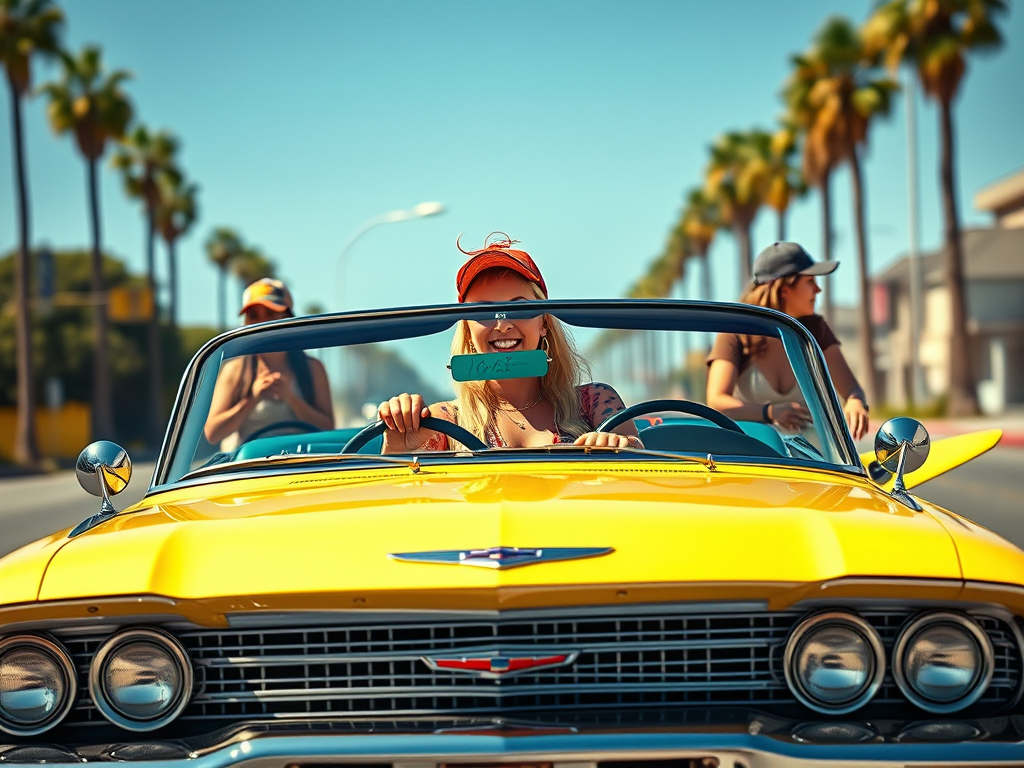
It is 2005. Juicy Couture velour tracksuits and Von Dutch trucker hats is the height of fashion. American pop star Gwen Stefani, accompanied by her four Japanese back-up dancers, the Harajuku Girls, are driving down the streets of San Fernando Valley, Los Angeles, in a bright yellow 1961 Chevrolet Impala. Together, they are performing her hit song “Hollaback Girl”. Following the success of her rock band No Doubt, Stefani has embarked on a solo career. Her debut solo album, “Love. Angel. Music. Baby”, has hit the charts — and with a bang. Fast-forward almost 15 years later, Stefani ultimately addresses the long-lasting accusations of cultural appropriation against her. Accusations that began with “Love. Angel. Music. Baby” and the Harajuku Girls.
Lolita, Kawaii and Visual Kei — the hip Tokyo neighbourhood of Harajuku is famous for its many styles of street fashion. Since the release of Stefani’s debut album, the American singer has repeatedly been accused of appropriating the Harajuku subculture. Often being accompanied by her Japanese back-up dancers, Jennifer Kita, Maya Chino, Rino Nakasone and Mayuko Kitayama, and launching Harajuku-inspired perfumes and clothing, Stefani has been accused of using it as a marketing tool. However, when speaking to Billboard in 2019, in an interview celebrating the 15th anniversary of her debut album, she defended herself, describing her Harajuku Girls era as a celebration of her love for Japanese culture, rather than cultural appropriation. “I get a little defensive when people call it culture appropriation, because if we didn’t allow each other to share our cultures, what would we be?” she told Billboard.
But what is cultural appropriation? At times called “cultural misappropriation”, the term describes events where members of a dominant culture adopt elements — such as language, behaviour or traditional styles — from members of disadvantaged minority cultures. From American singer Selena Gomez wearing bindis, a traditional Hindu forehead decoration, to members of the Kardashian dynasty repeatedly sporting box braids and cornrows, cultural appropriation seems to be everywhere. However, for some, the difference between appropriation and appreciation might be difficult to understand.
“There is a thin line between what’s considered appropriation and what’s viewed as appreciation. The debate over who decides which is which, and who is allowed and who isn’t, all warrants conversation and exploration,” says Dr. Anica Camela Mulzac. As a clinical psychologist and founder of consulting firm Race (+) Positive, Mulzac has gathered over ten years of experience in the field. She continues: “Cultural appropriation has always been an issue, but I think in recent years there has been more attention given to it. The rise of social media and the increased sharing of information within and across groups has heightened awareness of it.”
Dianne Lalonde, a PhD candidate at Western University in London, Canada, wrote a dissertation exploring the political problem of cultural appropriation. “While it is an issue when people generally engage in cultural appropriation, celebrities and brands have huge platforms and many fans so that changes the scale of the harm they could produce,” she says. In modern times, when cultural appropriation happens on a regular basis, it is important to recognise the harms of appropriating other cultures. “When a white celebrity wears cornrows they may be praised and seen as beautiful and creative; in comparison, when a black cultural member wears corn rows they may be criticised and told that is not appropriate for work and school,” Lalonde explains.
While the concept of cultural appropriation emerged decades ago, in the late 1900’s, the use of the term somewhat exploded in the late 2010’s. Millennials and Generation Z, referring to the demographic cohorts born between 1981 and present time, might have had something to do with that. McKinsey and Company states that nine out of ten Generation Z consumers “believe companies have a responsibility to address environmental and social issues”. Often seen as “woke” and more socially conscious, millennials and Generation Z are seemingly more aware of the term cultural appropriation than their predecessors. Likewise, although the concept of cultural appropriation was an issue predominantly recognised among scholars at first, it spread into the mainstream media in the 2000’s, alongside the rise of social media. One might wonder, has cultural appropriation become more common? Or are we becoming more aware of the social injustices around us?
“It is difficult to say if cultural appropriation is becoming more common, but I think it is fair to say that new technologies and globalisation have expanded the reach of cultural property, its appropriation, and concerns about the loss of culture,” Lalonde says.
Some say that the concept of cultural appropriation is somewhat excessive. When speaking at the Hay Festival Winter Weekend last week, Bernardine Evaristo, author of Booker Prize-winning novel “Girl, Woman, Other”, criticised cultural appropriation. Particularly, the way that other authors have been accused of appropriating other cultures when writing from the perspective of characters of cultures and ethnicities different to their own. Evaristo’s novel follows the lives of twelve characters of black and mixed-race ethnic groups. “This whole idea of cultural appropriation, which is where you are not supposed to write beyond your own culture and so on, is ridiculous. Because that would mean that I could never write white characters or white writers can never write black characters,” she said at the festival.
Growing up with rather politically engaged parents, Mauritius-born activist Yanisha Lallah has always been familiar with the issue of cultural appropriation. However, after moving to South Africa in 2012 and seeing appropriation of other cultures first-hand, her passion for activism flourished. “The protests for free education in 2015 seemed like the perfect time to raise awareness of cultural appropriation. Especially with white South Africans being so entitled and appropriating black and Indian cultures right and left.” Emphasising the fact that cultural appropriation is more than blackface and Halloween costumes, she said: “It’s more about understanding the economic gaps it is creating and the disrespect it brings to the people whose cultures these belong to.”
So, while cultural appreciation — or cultural exchange — might seem harmless to some, it is important to recognise there is an extremely fine line between that and the damaging patterns of cultural appropriation. Wearing dreadlocks, or Native American headdresses to a festival, should be seen as cultural appropriation, rather than a fashion statement. This misconception often stems from a lack of understanding about the history and significance behind these cultural symbols, which have deep roots and meaning for the communities that originated them. When individuals from outside these cultures adopt such styles without acknowledging their origins or the struggles associated with them, it trivialises the experiences and identities of those who hold these traditions dear.
Ultimately, cultural appreciation should be rooted in respect, education, and acknowledgment. Before adopting elements of another culture, we should ask ourselves: Are we honouring its origins, or simply borrowing it for aesthetic appeal? By making the effort to learn, listen, and uplift the voices of those within these cultures, we can move towards a more inclusive and respectful world — one where appreciation is celebrated without erasing the significance of cultural heritage.


 mandy makes.
Leave a comment